

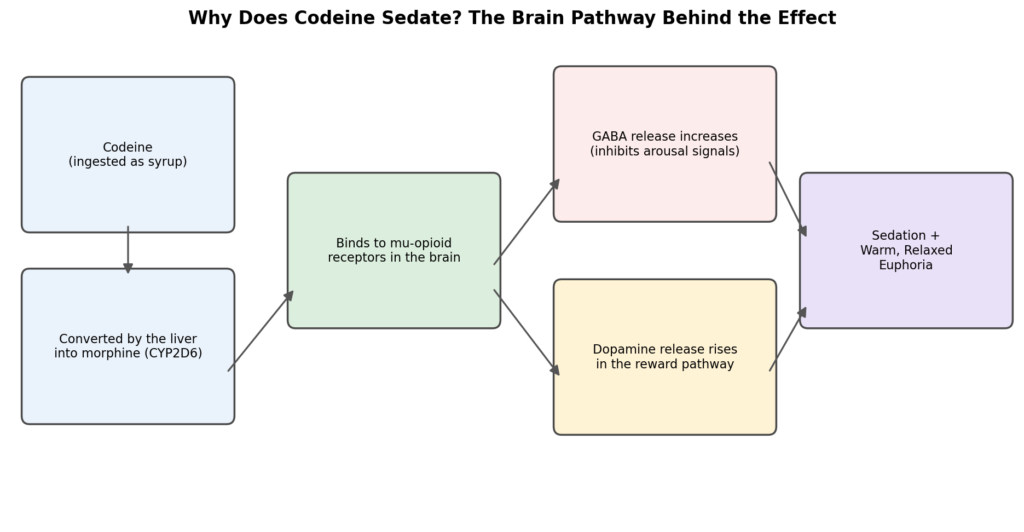
Why does codeine sedate? In short: codeine is converted by the liver into morphine, which binds to mu-opioid receptors throughout the brain and spinal cord. This binding increases inhibitory GABA signaling, calms the brain’s arousal centers, and triggers a dopamine surge in the brain’s reward pathway. The result is the drowsy, warm, relaxed, and euphoric feeling people associate with codeine syrup.
This article breaks down exactly what happens in the brain, why the syrup form feels stronger than tablets, who is most affected, and when that sedation becomes dangerous. It’s written for patients, caregivers, students, and anyone searching for a clear, medically grounded explanation of this sedative effect.
Why Does Codeine Sedate? A Quick Answer for Busy Readers
If you only remember one thing, remember this: codeine itself is a relatively weak opioid. Your liver enzyme CYP2D6 converts a portion of it into morphine, and it is morphine that does most of the heavy lifting. Once morphine reaches the brain, it locks onto mu-opioid receptors, which are concentrated in areas that control alertness, pain perception, breathing rate, and mood. That single receptor interaction explains almost every sedative and euphoric effect people report — which is exactly why this drug produces such reliable drowsiness compared to non-opioid cough medicines.
Understanding this mechanism matters, whether you’re a patient prescribed codeine syrup for a cough, a caregiver watching for side effects, or someone researching the risks of recreational misuse (sometimes called “lean” or “purple drank” when codeine syrup is mixed with soda and candy).
Why Does Codeine Sedate at the Molecular Level?
To really understand this sedative process, it helps to walk through the biology step by step.
1. Codeine Converts Into Morphine
Codeine is a prodrug — meaning it’s not very active on its own. About 5–15% of an oral dose is metabolized by the liver enzyme CYP2D6 into morphine. According to background pharmacology from Wikipedia’s overview of codeine, this conversion step is what gives codeine most of its analgesic and sedative punch, and it also explains why people metabolize codeine so differently — some people convert codeine to morphine very quickly (“ultra-rapid metabolizers”), which can make sedation and other effects noticeably stronger.
2. Why Does Codeine Sedate by Binding Opioid Receptors?
Once morphine is circulating, it binds to mu-opioid receptors (MOR) in the brainstem, thalamus, and limbic system. These receptors are part of the body’s natural pain-relief and reward system — the same system activated by endorphins after exercise, just far more intensely.
When mu-opioid receptors are activated:
- Pain signals are dampened
- Neurons that normally keep you alert become less active
- The brain’s “threat-monitoring” circuits quiet down
This is the core mechanism behind the effect: codeine is essentially hijacking a natural calming system and switching it on far more strongly than the body would on its own.
3. Why Does Codeine Sedate by Increasing GABA Activity?
Opioid receptor activation indirectly boosts GABA, the brain’s primary inhibitory (calming) neurotransmitter. Higher GABA activity slows down neuron firing across the brain, which produces the heavy eyelids, slowed reaction time, and “sinking into the couch” feeling that codeine syrup users commonly describe.

What Causes the Warm, Relaxed High From Codeine?
Sedation and euphoria are related but not identical, and understanding both fills out the full picture of this sedative-euphoric combination.
- The “warm” feeling comes partly from mild vasodilation (blood vessels relaxing slightly) and partly from reduced activity in the brain’s stress and pain-processing regions — the body simply has less to “brace against.”
- The relaxed feeling comes from GABA-driven inhibition described above, plus reduced signaling from the locus coeruleus, a brainstem region responsible for alertness and the body’s fight-or-flight response. Less locus coeruleus activity means less anxiety and more calm.
- The euphoria comes from dopamine release in the nucleus accumbens, the brain’s central reward hub. Opioids indirectly increase dopamine by inhibiting the neurons that normally keep dopamine release in check — so dopamine floods the reward circuit.
Put together, these three effects explain why this sedation feels pleasant rather than simply drowsy, which is also part of why codeine and other opioids carry a real risk of misuse and dependence.
Why Does Codeine Syrup Sedate More Than Codeine Tablets?
This is one of the most common follow-up questions people ask, and the answer comes down to absorption speed and dosing culture rather than a fundamentally different drug.
- Faster absorption — liquid formulations are typically absorbed slightly faster than tablets, producing a quicker onset of the sedative wave.
- Combination ingredients — many codeine cough syrups also contain promethazine, an antihistamine with its own strong sedative properties. Combining the two significantly amplifies drowsiness — this combination is a major reason cough syrup formulations feel far heavier than codeine alone.
- Dosing habits — syrup is easy to overconsume because it’s measured in spoonfuls or “sips” rather than fixed tablet units, which can lead to much higher effective doses than intended.
Factors That Change Why Codeine Sedates You
Not everyone experiences the same level of sedation from the same dose. Here are the main factors that determine how strongly someone feels it:
Dose
Higher doses mean more morphine produced, more receptor binding, and stronger sedation — the relationship is roughly dose-dependent up to a point.
Genetics (CYP2D6 Metabolism)
People are grouped into metabolizer types:
- Poor metabolizers convert very little codeine to morphine and may feel almost no effect.
- Ultra-rapid metabolizers convert codeine to morphine unusually fast, producing much stronger sedation and a higher overdose risk even at “normal” doses.
Tolerance
With repeated use, the brain reduces the number of active mu-opioid receptors (a process called downregulation). This explains the drop-off in sedation over time in regular users — and why people may increase their dose to chase the original effect, which raises the risk of dependence.
Combined Substances
Alcohol, benzodiazepines, antihistamines (like promethazine), and other sedatives all amplify codeine’s calming effects on the central nervous system — and this combination is responsible for the majority of serious opioid-related sedation emergencies.
Body Size, Age, and Liver/Kidney Function
Slower metabolism or reduced clearance (common in older adults or those with liver/kidney conditions) allows morphine to build up, deepening sedation.
When Sedation Turns Dangerous
Understanding why does codeine sedate also means understanding where the line is between “sleepy” and “medically dangerous.” The same mu-opioid receptors that cause drowsiness are also concentrated in the brainstem’s breathing control center. At high enough doses:
- Breathing becomes slow and shallow (respiratory depression)
- Oxygen levels drop
- In severe cases, breathing can stop entirely
This is the mechanism behind opioid overdose, and it’s the single most important safety reason to never exceed a prescribed or recommended codeine dose, and never combine codeine syrup with alcohol or other sedatives.
Warning signs of an opioid emergency include: extreme drowsiness that can’t be woken, slow or stopped breathing, blue-tinted lips or fingertips, and unresponsiveness. This is a medical emergency — call your local emergency number immediately if you see these signs.
Codeine Misuse, “Lean,” and Why It Sedates So Heavily
Recreational misuse of codeine cough syrup — often mixed with soda and candy and known by street names like “lean,” “purple drank,” or “sizzurp” — relies on exactly the mechanism described above, but at much higher and less controlled doses. Because the sedative and euphoric effects are dose-dependent, taking far more than a therapeutic amount dramatically increases the risk of:
- Severe respiratory depression
- Dangerous interactions with promethazine or alcohol
- Physical dependence and withdrawal
- Long-term changes to the brain’s reward system
If you or someone you know is using codeine syrup outside of medical guidance, this pattern of heavy sedation-seeking is a recognized warning sign of substance use disorder, not simply “liking how it feels.” Support is available and effective — see the safety section below.
For additional information about Codeine Misuse, see our previously published article, “How to Safely Obtain Stilpane Syrup,” which discusses the potential health risks of codeine misuse, the importance of medically supervised use, and ways to recognize possible complications. Read the previous article on Codeine Misuse
Safe Use, Dependence, and Getting Help
Codeine is a legitimate, effective medicine when used as prescribed for cough or mild-to-moderate pain. To use it safely:
- Take only the prescribed dose, at the prescribed interval
- Never combine it with alcohol, benzodiazepines, or other sedating antihistamines without a doctor’s explicit approval
- Store it securely, away from children and anyone who might misuse it
- Talk to your prescriber if you notice you need more to get the same effect — this can be an early sign of tolerance or dependence
If you’re worried about your own or someone else’s codeine use, reach out to a healthcare provider or a confidential substance use helpline in your country. In the United States, the SAMHSA National Helpline (1-800-662-4357) offers free, confidential support 24/7. Reaching out early is one of the most effective things you can do.
For more on how opioids affect the body and brain more broadly, see our related guide on how opioid painkillers affect the central nervous system
Community Q&A: Real Questions Readers Ask About Why Codeine Sedates
Compiled from common reader and forum questions to reflect real-world curiosity about this topic.
“I only took the recommended dose and still felt very drowsy — is that normal?” Yes. Individual metabolism (especially CYP2D6 activity) varies a lot, so a standard dose can feel stronger in some people than others. If drowsiness interferes with daily activities, talk to your prescriber about adjusting the dose or trying an alternative.
“Does codeine sedate less if I take it with food?” Food can slightly slow absorption and blunt the peak intensity of effects, but it doesn’t change the total amount of morphine your body eventually produces, so sedation will still occur — just somewhat more gradually.
“Why did codeine make me feel sedated the first time but not as much later?” This reflects tolerance — see the “Tolerance” section above. Reduced receptor sensitivity over repeated use is exactly what drives that decline in sedation with regular use.
FAQ: Why Does Codeine Sedate?
Why does codeine sedate more than other cough suppressants?
Most non-opioid cough suppressants (like dextromethorphan at normal doses) don’t strongly activate mu-opioid receptors or trigger the same GABA and dopamine changes. Codeine’s sedation comes specifically from its conversion to morphine and that morphine’s action on opioid receptors — a mechanism non-opioid alternatives simply don’t share to the same degree.
Why does codeine sedate you but also make you feel euphoric at the same time?
Sedation and euphoria come from two overlapping but distinct effects of the same receptor activation: increased GABA activity slows the brain down (sedation), while increased dopamine release in the reward pathway creates pleasure (euphoria). Both happen from the same opioid receptor trigger, which is why the two feelings are so often reported together.
Why does codeine sedate some people much more than others?
Genetic differences in the CYP2D6 liver enzyme mean some people convert far more codeine into morphine than others. Ultra-rapid metabolizers experience notably stronger sedation, while poor metabolizers may barely feel an effect at all.
Why does codeine sedate less after taking it regularly for a while?
Repeated opioid receptor activation causes the brain to reduce the number of active receptors (tolerance). That’s why the sedative effect fades over time — and why increasing the dose to “catch up” with it is dangerous rather than a normal fix.
Is it dangerous that codeine sedates the same brain areas that control breathing?
Yes, at high doses. The brainstem centers that control breathing sit close to the areas responsible for sedation, so overdose-level doses can slow or stop breathing. This is why codeine should never exceed prescribed amounts or be combined with alcohol or other sedatives.
Is codeine syrup safe to use just for its sedative effect (to help sleep)?
No. Codeine is not approved or recommended as a sleep aid. Using it specifically to chase sedation increases the risk of tolerance, dependence, and dangerous interactions. Speak with a healthcare provider about approved treatments for sleep problems instead.
Key Takeaways: Why Does Codeine Sedate?
To summarize why does codeine sedate: your liver converts codeine into morphine, morphine binds to mu-opioid receptors across the brain, and that single interaction triggers a cascade — more GABA (calming), less locus coeruleus activity (less alertness), and a dopamine surge in the reward pathway (euphoria). Dose, genetics, tolerance, and combined substances all shape how strong that sedation feels, and at high doses the same mechanism can dangerously slow breathing.
If you take codeine syrup for a medical reason, use it exactly as prescribed, watch for signs of growing tolerance, and never mix it with alcohol or other sedatives. If sedation-seeking becomes the goal rather than a side effect, that’s a sign to talk to a healthcare professional.
Medical disclaimer: This article is for general educational purposes only and is not a substitute for professional medical advice, diagnosis, or treatment. Always consult a licensed healthcare provider about your specific medical situation, including questions about prescribed codeine use.
About the review process: This article was researched using pharmacology references, including the Wikipedia entry on codeine, and written to reflect current, general clinical understanding of opioid pharmacology. It should be reviewed by a licensed clinician before publication on a health
Related reading on this site: [Link to your related internal article here] — replace with a relevant page, such as a guide on opioid safety, cough medicine comparisons, or substance use support resources on your own website, using descriptive anchor text like “how opioid tolerance develops” or “signs of codeine dependence.” </div>