

When your throat feels raw and every cough scrapes the back of it, the choice at the pharmacy shelf usually comes down to two options: a lozenge or a syrup. Are lozenges more effective? For pharyngeal cough specifically — the kind that starts as throat irritation rather than deep chest congestion — the short answer is yes, in most everyday cases, because lozenges keep active ingredients in direct, prolonged contact with the exact tissue that is inflamed. This article breaks down the science, the evidence, and the practical guidance you need to choose the right format for your symptoms.
Are Lozenges More Effective? Understanding Local Efficacy in the Throat
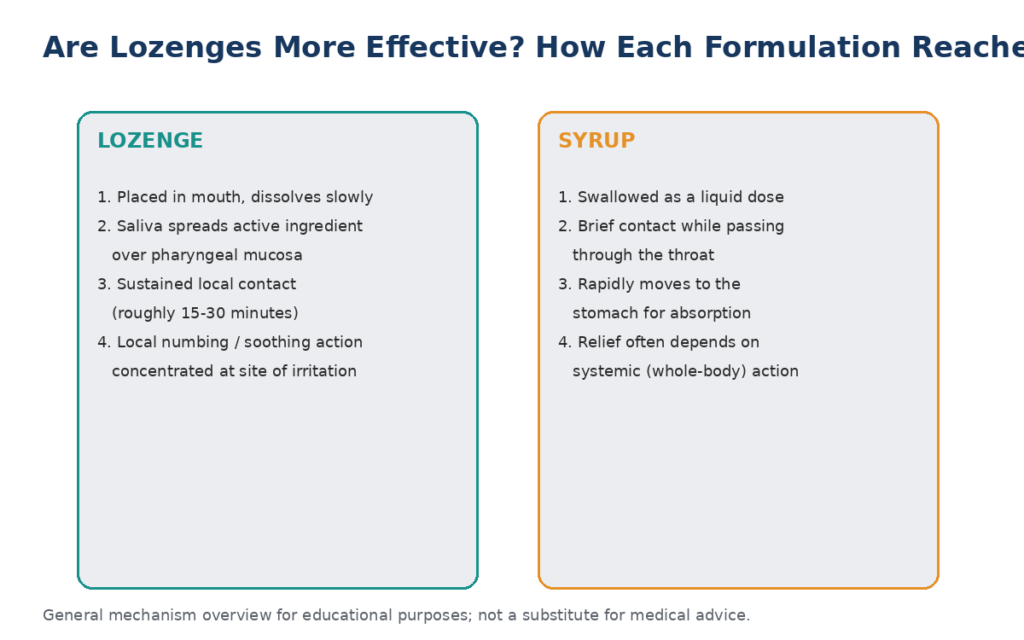
“Local efficacy” means how well a medicine works right where it’s applied, instead of relying on the bloodstream to carry it there. For pharyngeal cough — a cough triggered by irritation, dryness, or inflammation of the pharynx (the muscular tube behind your nose and mouth) — local efficacy matters more than systemic absorption. So, are lozenges more effective at achieving this kind of targeted relief than a liquid you swallow in seconds? Pharmacologically, the answer leans toward yes, because a lozenge is designed to dissolve slowly, bathing the pharyngeal mucosa in active ingredient for an extended period rather than passing through it quickly.
Are Lozenges More Effective at Increasing Contact Time With the Throat?
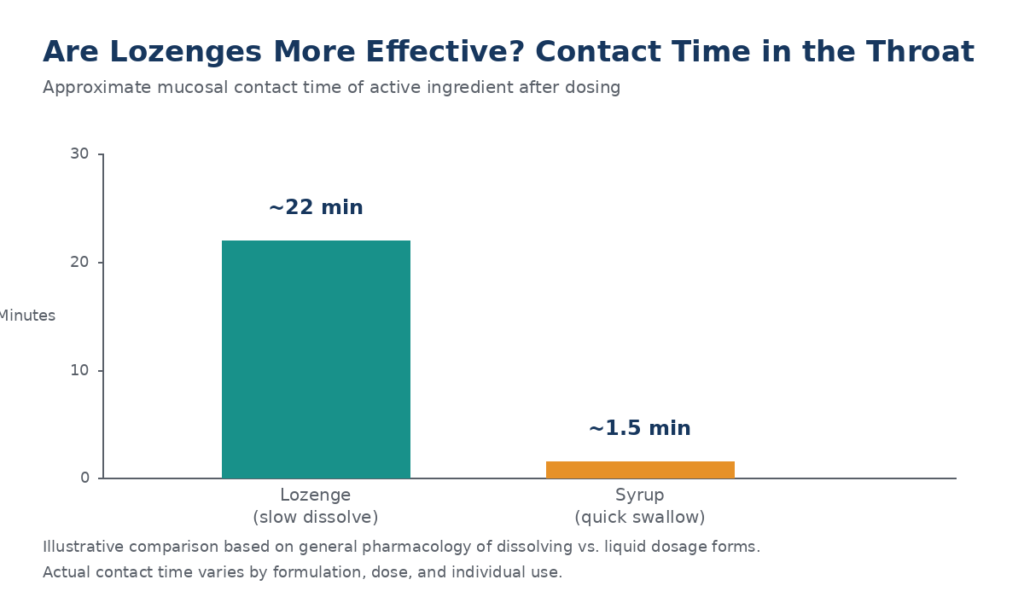
Contact time is the single biggest factor separating these two formats. A lozenge typically takes 15 to 30 minutes to dissolve completely, during which saliva continuously spreads the active ingredients — menthol, benzocaine, honey extracts, zinc, or antiseptics — across the inflamed lining of the throat. A syrup, by contrast, is swallowed in a matter of seconds, giving the pharyngeal tissue only a brief moment of exposure before the dose moves toward the stomach. When it comes to maximizing local exposure time, the physics of dissolution versus swallowing gives lozenges a clear structural advantage.
How Lozenges Work: The Mechanism Behind Local Action
Lozenges are built to melt slowly in the mouth. As they dissolve, they:
- Stimulate saliva production, which naturally soothes a dry or irritated throat
- Release active ingredients gradually and directly onto the pharyngeal mucosa
- Numb localized nerve endings (with ingredients like benzocaine or menthol), reducing the urge to cough
- Coat the throat with a thin protective layer that limits further irritation from talking, swallowing, or cold air
This slow-release mechanism is precisely why clinicians and pharmacists often ask patients with a scratchy, irritation-driven cough whether they’ve tried a lozenge first.
How Syrups Work for Pharyngeal Cough
Cough syrups are not without merit — they simply work differently. Many syrups combine several ingredients (an antitussive, an expectorant, an antihistamine, or a decongestant) into a single dose, which is convenient when a cough is accompanied by congestion, a runny nose, or multiple cold symptoms at once. Because syrups are swallowed and absorbed systemically, their effects reach beyond the throat to address symptoms elsewhere in the respiratory tract. The trade-off is that the throat itself receives only a fleeting rinse of the active ingredient before it’s gone.
Are Lozenges More Effective Than Syrups? Comparing the Evidence
Clinical research on sore throat and pharyngeal cough treatments consistently points to one theme: formulations that stay in contact with the pharyngeal mucosa longer tend to produce faster, more concentrated local pain and cough relief. So where does that leave the core question — are lozenges more effective when tested head-to-head against liquid alternatives?
Are Lozenges More Effective in Clinical Studies on Sore Throat and Cough?
Several controlled studies support this pattern:
- A meta-analysis of randomized trials on ambroxol lozenges for pharyngitis found meaningful pain reduction compared to placebo over a 3-hour observation window, with the majority of patients reporting good or very good relief within a day of starting lozenge treatment.
- Research on multi-herbal menthol lozenges for acute sore throat and cough reported measurable symptom improvement across large patient cohorts, reinforcing the role of sustained mucosal contact in symptom control.
- A randomized controlled trial on botanical lozenges for chronic pharyngitis found significantly higher improvement rates in throat itching, dryness, and irritation-related cough compared to a control group, along with better patient adherence to treatment.
- Analyses of zinc lozenges versus zinc syrup have specifically noted that slowly dissolving lozenges create a local pharyngeal effect that a rapidly swallowed liquid dose does not replicate.
Taken together, this body of evidence supports the idea that when a cough originates from throat-level irritation rather than chest congestion, lozenges tend to outperform syrups on measures of local, fast-onset relief.
Are Lozenges More Effective for Reducing Cough Frequency?
Pharyngeal cough is often a reflex response to irritation and dryness rather than mucus production. Because lozenges directly soothe and lubricate the irritated tissue that triggers the cough reflex, many users notice a reduction in coughing frequency within minutes of use — an effect tied directly to local contact rather than any drug reaching the bloodstream. Syrups can also reduce cough frequency, particularly antitussive formulas, but the throat-specific soothing effect is generally less pronounced.
Are Lozenges More Effective for Sore Throat Pain Relief?
Pain relief is one of the clearest areas where lozenges show an edge. Because pain receptors in the pharynx are directly exposed to the dissolving lozenge for an extended period, numbing and anti-inflammatory ingredients can act right at the source of discomfort. Syrups can still relieve throat pain, especially formulas containing soothing agents like honey or glycerin, but the exposure window is much shorter.Learn what makes cough syrup work faster for quicker symptom relief: https://syrupdreams.com/what-makes-cough-syrup-work-faster/
Ingredients That Matter: Menthol, Honey, Benzocaine, and More
Not all lozenges (or syrups) are equal — ingredients drive outcomes as much as format does:
- Menthol – creates a cooling sensation that can reduce the perceived urge to cough
- Benzocaine – a mild local anesthetic that numbs pharyngeal nerve endings
- Honey extract – coats and soothes irritated mucosa
- Zinc compounds – may shorten the duration of throat-related cold symptoms when delivered locally
- Antiseptics (e.g., cetylpyridinium chloride) – help manage minor throat infections locally
Understanding what’s inside a product often matters more than whether it’s a lozenge or syrup, but the delivery format still shapes how long those ingredients stay in contact with the affected tissue.
When Are Lozenges More Effective Than Syrups? Best-Use Scenarios
Lozenges tend to perform best when:
- The cough is dry, tickly, or clearly linked to throat irritation rather than congestion
- Sore throat pain is the primary complaint
- You need discreet, on-the-go relief (during meetings, travel, or public speaking)
- You want to avoid drowsiness often associated with certain syrup formulas
- Symptoms are mild to moderate and isolated to the throat
Are Lozenges More Effective for Children? Safety Considerations
Lozenges are generally not recommended for children under 4–6 years old due to choking risk, which is an important safety exception to keep in mind. For older children and adults who can safely suck on a lozenge without swallowing it whole, lozenges remain a strong choice for isolated throat irritation. For younger children, age-appropriate syrup formulations are usually the safer and more practical option, even though the question of whether lozenges are more effective would technically still apply to older siblings or adults in the same household.
When Might Syrups Be a Better Choice?
Syrups often make more sense when:
- Cough is accompanied by chest congestion, mucus, or a runny nose
- Multiple cold or flu symptoms need to be addressed with one product
- The person cannot safely suck on a lozenge (very young children, certain swallowing difficulties)
- A combination formula (decongestant plus antitussive) is preferred for nighttime symptom control
Rather than viewing lozenges and syrups as competitors, many pharmacists recommend matching the format to the symptom pattern — and even using both at different times of day depending on what’s bothering you most.For a complete comparison of cough syrups for dry and chesty cough in adults, check out our in-depth guide: https://syrupdreams.com/best-cough-syrup-for-dry-cough-vs-chesty-cough-adults/
What Do Readers and Users Say? Real-World Experiences
Across community health forums and patient reviews, a recurring pattern emerges: people with a scratchy, dry, “tickle in the throat” type of cough consistently report that lozenges bring faster relief than syrup, while people with chesty, mucus-heavy coughs often prefer syrup for its broader symptom coverage. Several users have described sucking on a menthol or honey lozenge as giving near-immediate, if temporary, relief — echoing what the clinical research above suggests. If you’ve tried both, sharing your own experience in the comments can help other readers decide which option fits their symptoms best.
Expert Tips: Choosing Between Lozenges and Syrups
- Match the format to the trigger: throat irritation favors lozenges; congestion favors syrup
- Check ingredient lists for actives that target your specific symptom (pain, cough reflex, dryness)
- Don’t exceed the recommended dose of either format — more lozenges per day does not equal faster healing
- If symptoms persist beyond a week, or you develop a fever, difficulty swallowing, or breathing issues, seek medical advice rather than relying on either option indefinitely
For general background on how over-the-counter cough and cold products are classified and used, see this overview on”https://en.wikipedia.org/wiki/Cold_medicine“.
You may also find it useful to read our related guide, 10 Things to Know Before Taking Cough Syrup, before deciding which format is right for you. (
Final Verdict: Are Lozenges More Effective?
For pharyngeal cough driven by localized throat irritation, are lozenges more effective than syrups? Based on both the mechanism of action and the available clinical evidence, the answer is generally yes — lozenges offer superior local efficacy because they maximize contact time with the inflamed tissue. Syrups remain valuable, particularly when cough is part of a broader set of cold symptoms or when swallowing a lozenge safely isn’t possible. The best approach is to match the treatment to the type of cough you actually have, rather than assuming one format is universally superior.
Frequently Asked Questions: Are Lozenges More Effective?
Are lozenges more effective than syrup for a dry, scratchy cough? Yes, in most cases. A dry or tickly cough is usually caused by irritation of the pharyngeal lining, and lozenges keep soothing and numbing ingredients in contact with that tissue far longer than a swallowed syrup does.
How long does a lozenge need to dissolve to work well? Most medicated lozenges are designed to dissolve slowly over 15 to 30 minutes. Letting the lozenge dissolve naturally, rather than chewing or swallowing it quickly, is what allows it to achieve its intended local effect.
Can I use a lozenge and a syrup on the same day? Generally yes, as long as you don’t exceed the recommended daily dose of any shared active ingredients in either product. Check labels carefully, and ask a pharmacist if you’re combining multiple over-the-counter products.
Are lozenges more effective than syrup for children? Not necessarily, and safety comes first. Lozenges pose a choking risk for young children and are typically not recommended under age 4–6. Age-appropriate syrup is usually the safer choice for younger children, even if lozenges offer stronger local action for older children and adults.
Do lozenges actually stop a cough, or just mask the discomfort? Lozenges primarily soothe the irritation that triggers a pharyngeal cough reflex. By reducing dryness and numbing sensitive nerve endings, they can genuinely reduce the frequency of coughing episodes, not just mask the sensation temporarily.
When should I see a doctor instead of relying on lozenges or syrup? If your cough or sore throat lasts more than 7–10 days, worsens, or comes with fever, difficulty swallowing, drooling, or breathing trouble, stop self-treating and seek medical care, since these can signal a condition that needs professional evaluation.
Are lozenges more effective for sore throat pain specifically, versus cough? Yes — pain relief is one of the areas where lozenges show the clearest advantage, because numbing and anti-inflammatory ingredients act directly on exposed pharyngeal pain receptors during the dissolving process.